Turning "House-Effect" Psychology into High-Ownership Engineering & Product Teams
Intro -- The Parents'-House Effect
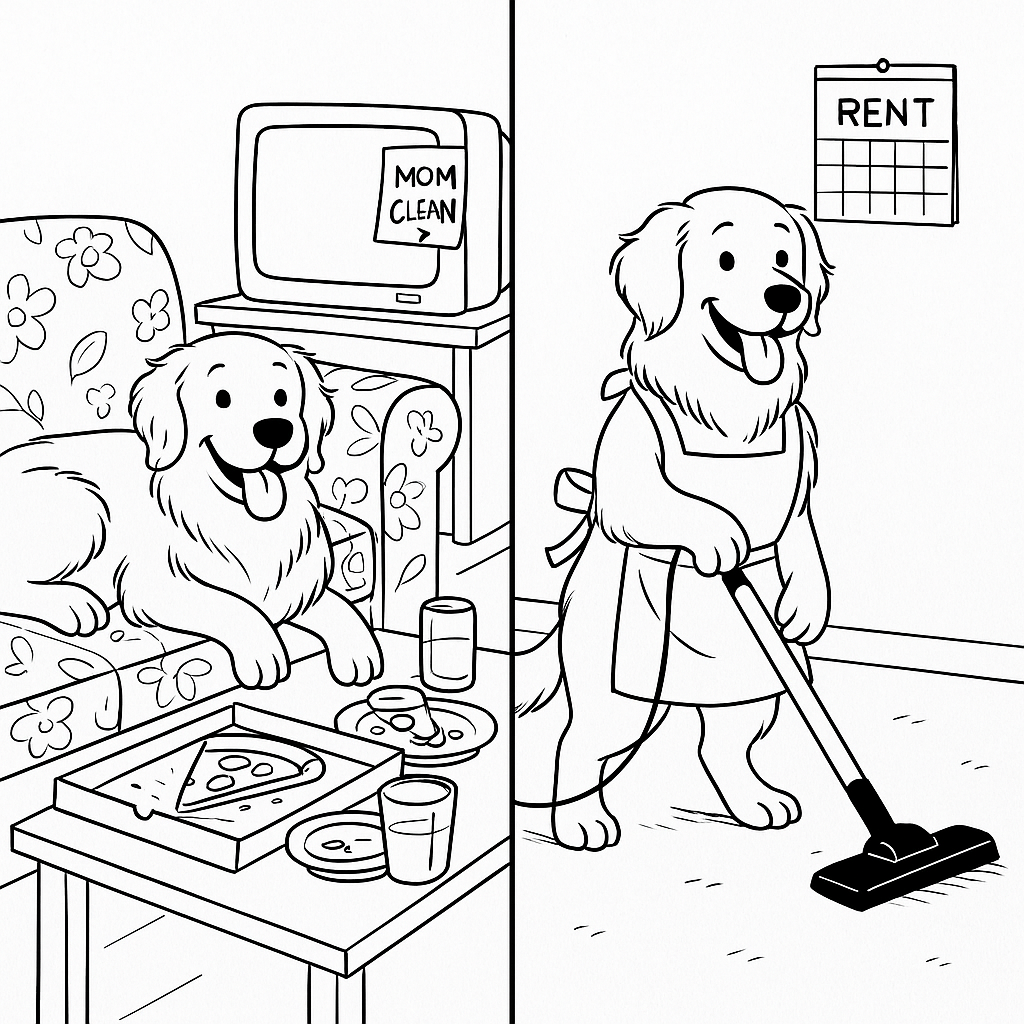
Ever notice how a quick visit to your parents' place turns you right back into your teenage self? You sleep till noon, raid the fridge, and somehow the dirty dishes magically "don't exist." Then you return to your own apartment, and -- boom -- suddenly you're wiping counters, paying bills on time, maybe even tackling that IKEA bookcase you kept putting off.
Nothing about your skills changed on the car ride home. What shifted was ownership. When the space is ours, responsibility sticks.
Today we'll take a deeper look at this effect in the IT world and how today's Leaders can use it to improve company performance.
Ownership Wiring 101
If it feels like mine, I'll sweat the details.
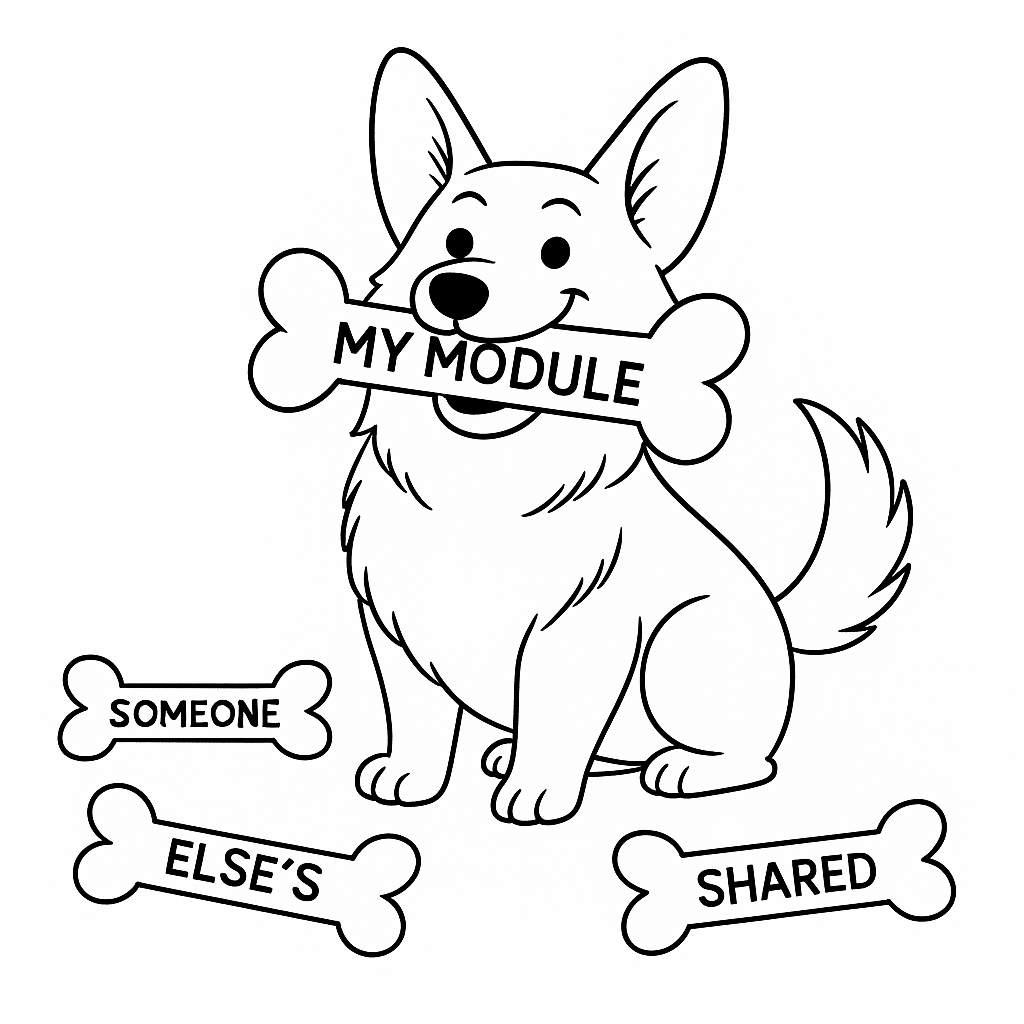
Our brains treat mine differently from yours. Researchers named this the Endowment Effect: in classic studies, participants demanded nearly double the price to part with a coffee mug they had just been given compared with what they would have paid for it moments earlier. That tiny spark of ownership flipped a switch -- people suddenly felt proud of the thing, pushed harder to protect it, and hated the idea of losing it.
Inside a software organisation the same circuitry fires. When an engineer is named steward of the logging pipeline, dashboards become tidier and incidents vanish faster. When a product manager takes charge of a product and carries the adoption and revenue targets that come with it -- backlogs stay trim, A/B tests appear, and unwanted scope is gracefully escorted out.
Psychologists unpack this feeling of possession into four uplifting forces -- self-efficacy, accountability, belonging, and identity -- plus a darker shadow, territoriality.
2. Diffusion & the Messy Kitchen at Work
When everyone is responsible, no one actually is.
In 1968, psychologists Bibb Latane and John Darley pumped smoke into a laboratory waiting room. When a single participant sat alone, three-quarters reported the danger within two minutes; when three strangers shared the room, that figure crashed below forty percent. The pair coined it the bystander effect: the more witnesses, the less each feels accountable.
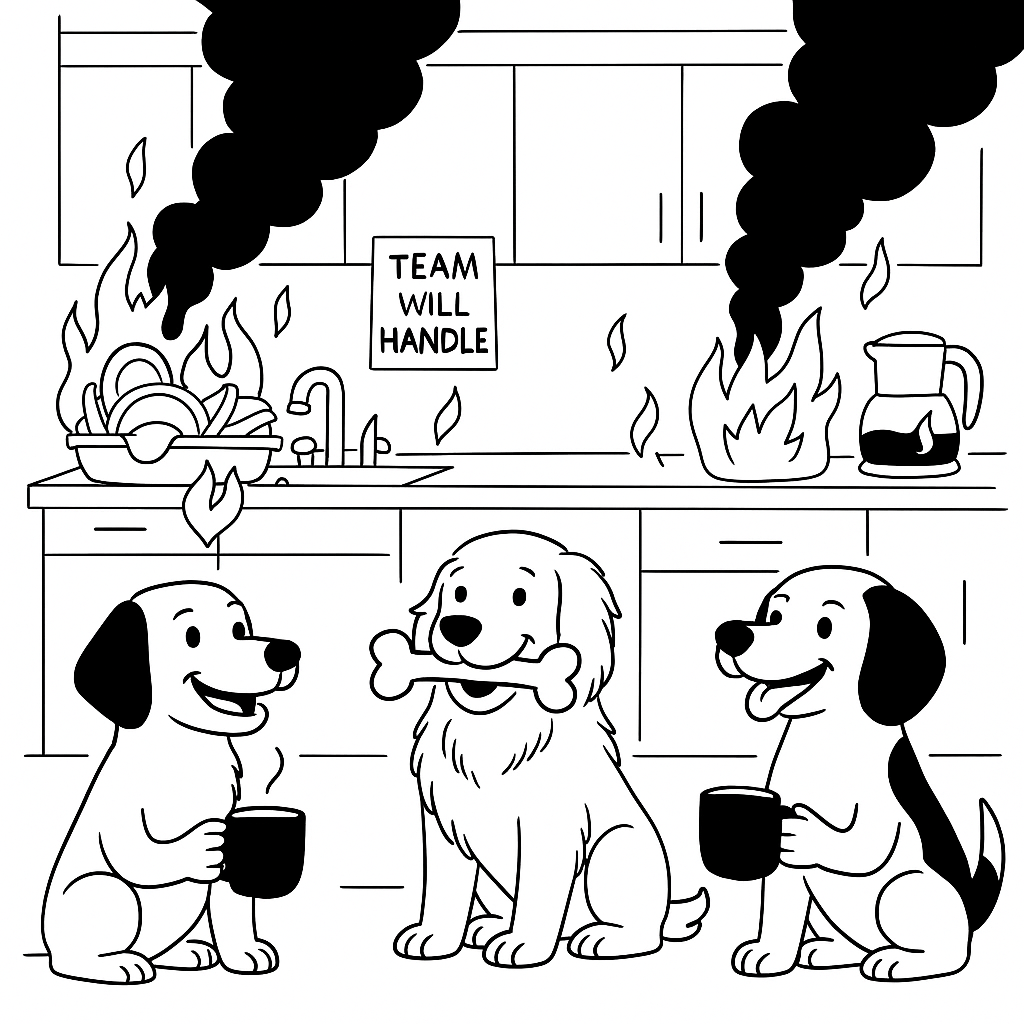
Your parents' kitchen runs on the same wiring. If "someone" scrubs yesterday's pans, you happily finish your coffee. Multiply that mindset by a twenty-person engineering org, and you get code rot on an industrial scale:
- Lingering tech debt. A flaky integration test fails intermittently for months because no engineer's name is on the ownership doc.
- Sprawling epics. A roadmap item drifts across sprints, accruing zombie subtasks, because every PM could prune it -- and so none does.
- Security patches deferred. A critical library update waits until the compliance audit looms because the work was "shared by platform."
The antidote is simple but radical: attach a human face to every artefact. When build-pipeline reliability becomes Maya's module and onboarding-flow conversion is Ali's, the lingering to-dos finally move from the backlog to "done."
3. Manager Playbook -- Engineering the Sense of "Mine"
Design stewardship so it happens by default -- not by heroics.
Forget Gantt-charts and ninety-day plans; ownership begins with three blunt questions:
- Where is the neglected work? Open your issue tracker or service catalogue and highlight every item whose owner field reads "Team," "Platform," or -- worst -- blank. These abandoned corners are breeding grounds for entropy.
- Who already feels the pain? The best steward is the person itching to fix the mess. Proximity to frustration fuels initiative far better than top-down assignments.
- What decision rights are missing? Responsibility without control is theatre. Before you anoint anyone, list the levers they'll actually be allowed to pull -- code merges, release toggles, scope cuts, budget calls.
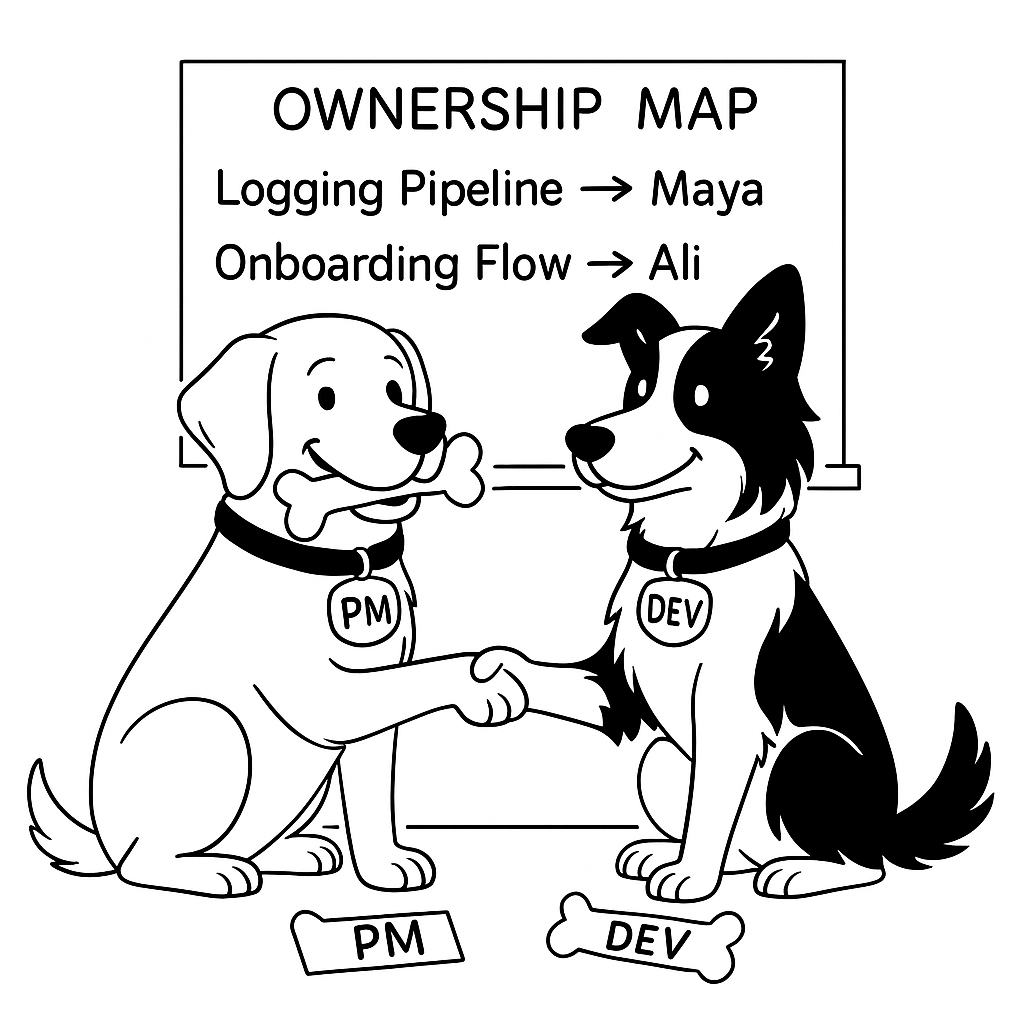
With those answers in hand, take four concrete steps of action:
- Name real stewards. Attach a human face -- ideally a developer-PM duo -- to each neglected zone, and announce their mandate publicly. Identity flips the ownership switch.
- Grant tangible agency. Write down the precise decisions the pair controls, along with one vivid metric that defines success. Authority + accountability beats either alone.
- Surface the caretaking. Give stewards a recurring five-minute slot in sprint review to showcase clean-ups, metric trends, and small delights. Visibility turns maintenance into status, not busywork.
- Refresh, don't abandon. Every few months, review each stewardship: renew thriving owners, rotate to spread context, or retire roles once the domain reaches boring stability -- which is a feature, not a failure.
Once the first forgotten module blossoms, volunteers queue for the next. The kitchen starts cleaning itself.
4. Pitfalls & Safeguards
Ownership has a dark side: territoriality. In low-trust teams, strong ownership can calcify into gate-keeping, knowledge hoarding, or the dreaded "my-code-my-rules" stand-off.
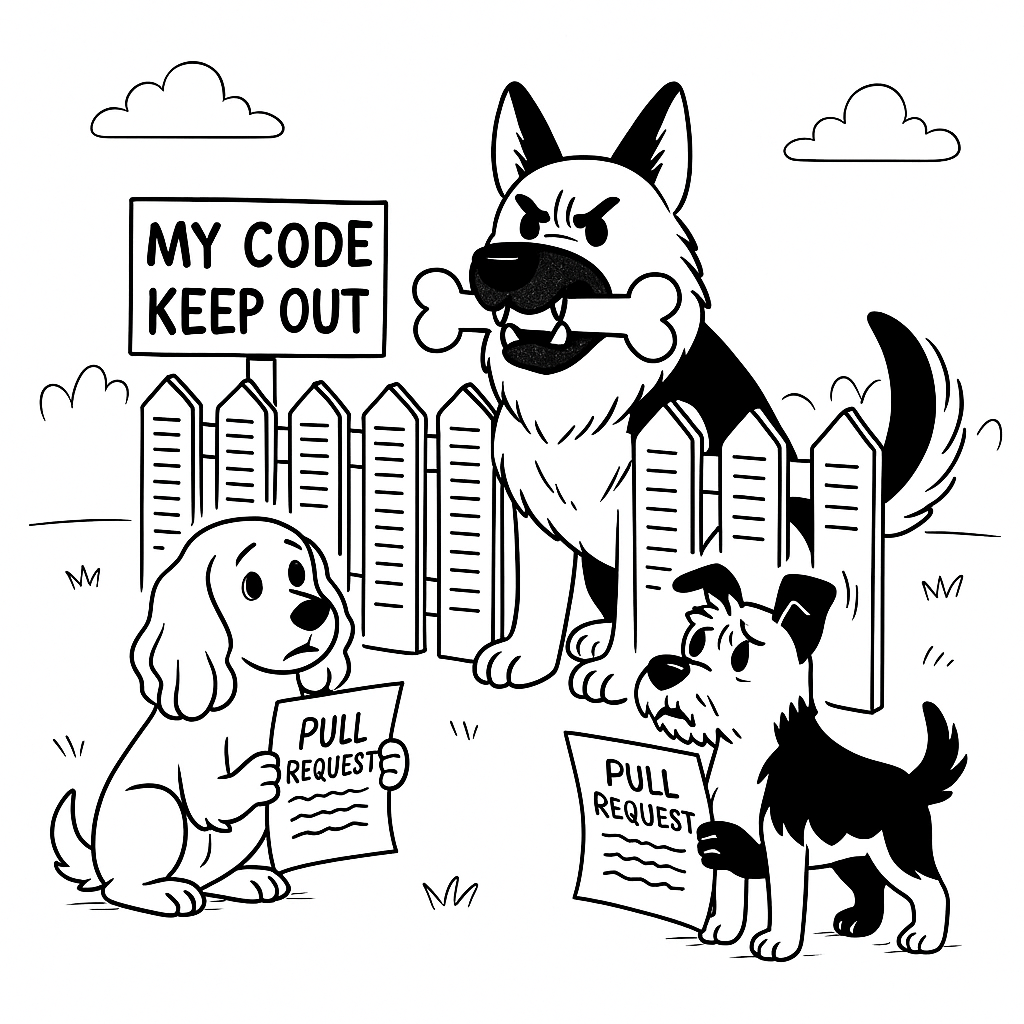
- Antidote -- widen the doorway. Rotate pair-programming partners, run cross-team code reviews, and ground objectives in shared OKRs. Publish architectural decision records and host open "steward office hours" so questions flow without bruising egos. When dismissive PR comments or secretive Slack threads surface, intervene early with coaching rather than blame.
- Single-point risk -- bus-factor <= 1. Holidays, resignations, or burnout cripple delivery if a lone steward is the only key-holder. Counter with second stewards, explicit succession checklists, and recurring teach-backs where owners walk teammates through critical paths.
- Context drift. Long-term stewards can grow attached to legacy assumptions. Schedule quarterly "fresh-eyes" reviews where an external dev or PM challenges design decisions and nudges refactoring.
- Perfectionism stalls. Pride of ownership sometimes morphs into over-polishing. Keep flow healthy with a lightweight Definition of Done and throughput metrics (lead time, deployment frequency) that reward shipping and stewardship.
Conclusion -- From Houseguests to Stewards
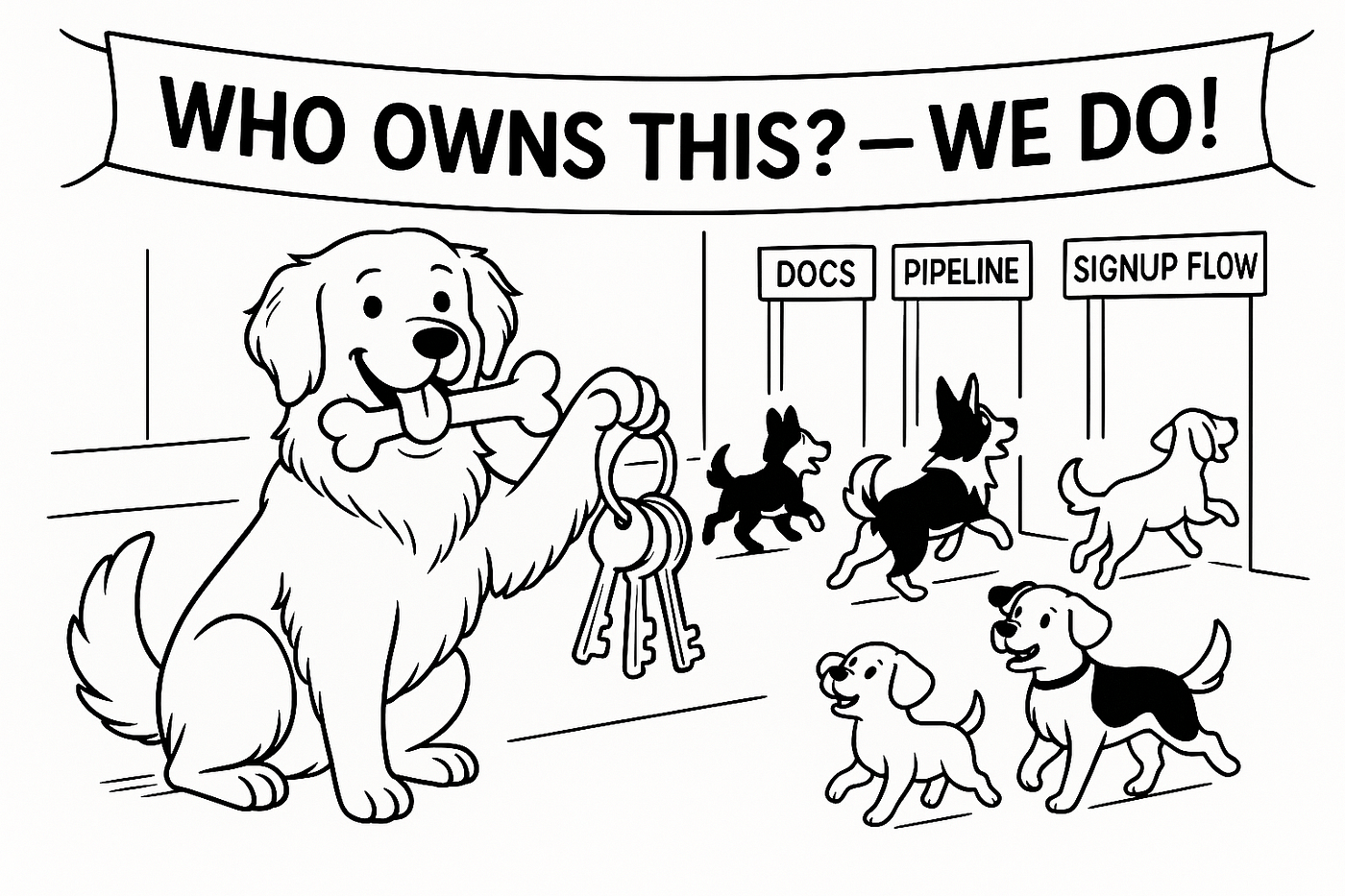
When people feel like polite tenants, they wait to be served; hand them the keys, and they start rearranging furniture for the better. The parents'-house effect is more than a quirk -- it's a management lever: ownership is the shortest route to care.
Try this tomorrow:
- Pick one neglected corner. A flaky test suite, a zombie epic, an unloved microservice -- anything gathering dust.
- Name real stewards. Pair a developer and a product manager, publish their mandate, and let the team know the buck stops with them.
- Give them a single metric. Error-budget burn, activation %, or load time -- whatever best signals progress.
- Schedule a review in four weeks. Not to micromanage, but to spotlight the uplift -- and to ask, "Where do we try this next?"
Lightweight, visible, and immediately contagious, this exercise turns caretaking into culture. Soon every retro ends with a new question -- Who owns this? -- and the answer will never again be "no one."