Let's get a deep dive into how to sunset a product. Sunsetting or pivoting a product is a normal part of the product development lifecycle. Therefore, it is important to be able to do this properly. The entire process, from making the initial decision to addressing the technical, communication, and customer support aspects. We'll also explore alternatives to sunsetting, like revitalizing a product or integrating it with others, and discuss how to manage your internal team and their concerns during this transition.
Basic Reasons for Sunsetting
Product closures usually occur during the decline phase, allowing companies to manage the decline early and prepare for new products or services. However, sometimes project closures can also occur before market entry if expected performance does not match actual forecasts or if the company's direction no longer matches the product's direction.
There are several reasons why a company might choose to sunset a product:
- Technological Advancements: As technology evolves, older products may become obsolete.
- Resource Allocation: Maintaining and supporting aging products can be resource-intensive.
- Market Changes: Consumer preferences and market trends can shift rapidly.
- Quality and Reputation: Older products that are no longer up to current standards can harm a company's reputation.
- Cost Efficiency: As products age, they may become more expensive to maintain and support.
- Regulatory Compliance: New regulations or changes in compliance standards can render some products non-compliant.
- Strategic Focus: Companies often refine their strategic direction, and sunsetting products that don't align with new goals allows them to stay focused.
- User Experience: Phasing out older products can enhance the overall user experience by encouraging customers to adopt better alternatives.
- Expected Performance Mismatch: Sometimes, project closures can occur before market entry if expected performance does not match actual forecasts.
- Company Direction Misalignment: Project closures can also occur if the company's direction no longer matches the product's direction.
Phases of Product Sunsetting
The process of sunsetting a product can be broadly categorized into six phases:
- Curiosity: This phase involves asking questions about whether a product needs to be sunsetted and gathering initial data to support the decision.
- Brainstorming: Generate ideas about how the sunsetting process might unfold and what changes need to be made.
- Discovery: Conduct research and experiments to gather more information and validate assumptions. This might involve prototyping alternative solutions or gathering customer feedback.
- Communication: Inform all stakeholders, including internal teams and customers, about the sunsetting decision and timeline.
- Development: Begin making the necessary changes to the product, such as phasing out features or migrating data.
- Measurement: Monitor the impact of the sunsetting process and gather data to evaluate its success.
1. Data Collection and Analysis
Before initiating the sunsetting process, it's crucial to secure internal buy-in for the end-of-life plan. Discuss the potential impact of sunsetting with stakeholders across different departments to ensure alignment and address any concerns. This collaborative method promotes a shared understanding of the rationale behind the decision and helps to achieve consensus.
Next, gather comprehensive data to make informed decisions. Analyze: product performance metrics, customer feedback, and market trends to understand the product's viability and the potential impact of its discontinuation. This data-driven approach helps understand sunset rationale and supports communication with stakeholders.
Consider the following questions when analyzing a product for sunsetting:
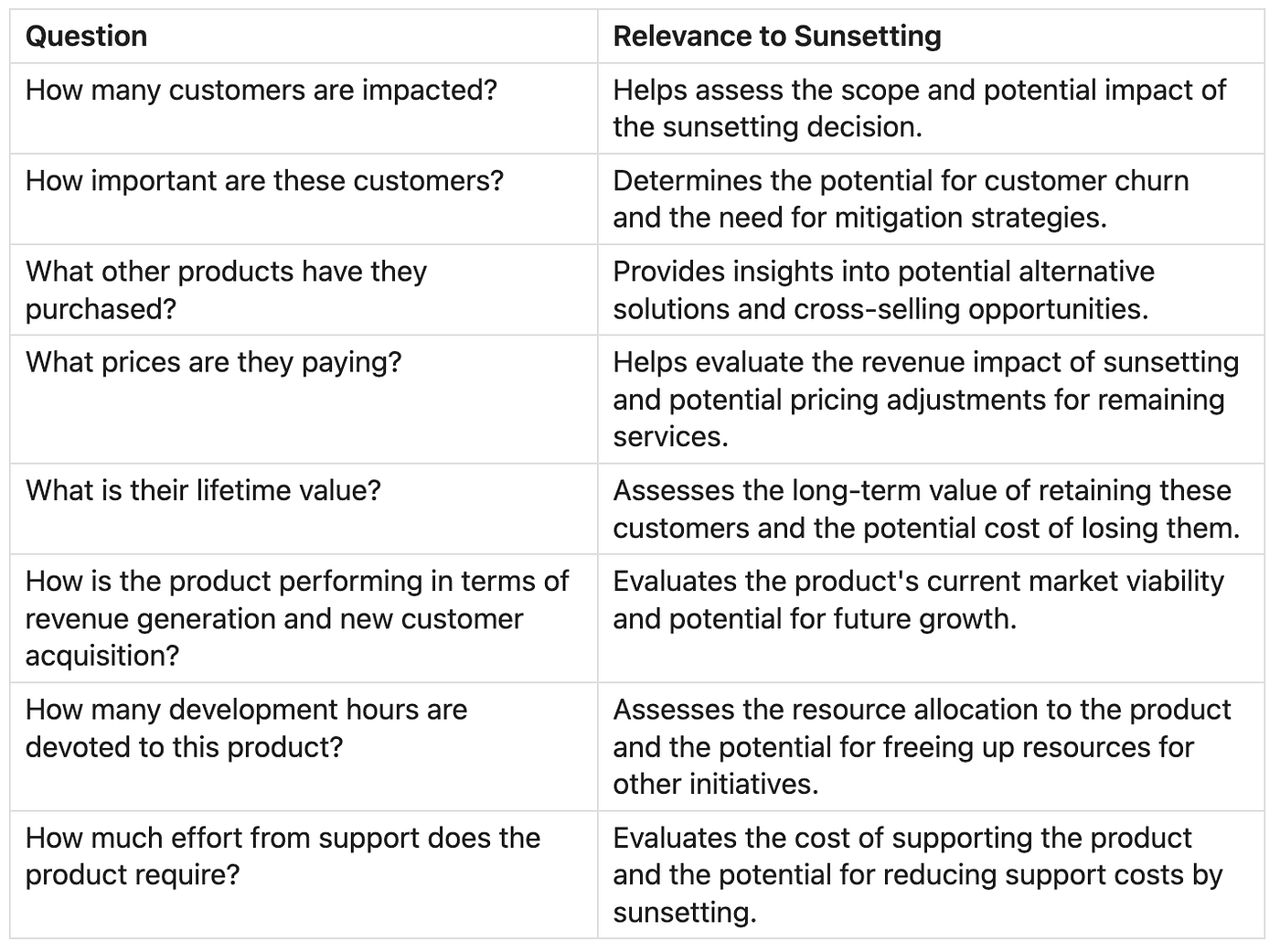
In addition to these questions, consider the following characteristics of products that might be good candidates for sunsetting:
- Declining Margin: The product has a year-on-year decline in margin.
- Negative Customer Feedback: Customers are expressing dissatisfaction with the product's features or performance.
- High Maintenance Cost: The product requires significant investment to maintain customer usage and satisfaction.
- Market Shift: The product is in a market that the company no longer wishes to operate in.
- Competitive Disadvantage: Competitors offer similar products with lower cost structures.
- Availability of Alternatives: The company has another innovative product that can serve as a suitable alternative.
- Resource Drain: The product requires development resources that could be better allocated to other high-growth products.
Checklist
- Define Objectives: Clearly outline the goals of sunsetting the product and the key questions that need to be answered through data analysis.
- Identify Data Sources: Determine the relevant data sources, including product usage data, customer feedback, financial records, market research, and competitor analysis.
- Collect Data: Gather data from all identified sources, ensuring data integrity and accuracy.
- Analyze Data: Analyze the collected data to understand product performance, customer behavior, market trends, and financial implications.
- Develop Insights: Draw meaningful insights from the data analysis to inform decision-making regarding the sunsetting process.
- Document Findings: Document the data analysis process, findings, and insights in a clear and concise report.
- Inform the Team: Share the initial findings with the team lead and product-focused team members. This will: keep them informed of the process, allow them to provide context or insights based on their knowledge of the product and customers, and let them start thinking about potential implications and next steps.
- Share and Discuss: Broaden the discussion to include other stakeholders and discuss the implications of the findings for the sunsetting process.
2. Exploring Alternatives to Sunsetting
Once the impact of sunsetting is understood, explore alternative options.
- Migration Path: Can you provide a migration path for existing customers to a newer product or platform? This can help retain customers and minimize disruption. It's important to highlight that sunsetting can actually enhance the overall user experience by encouraging customers to adopt better, more efficient alternatives.
- Product Packaging: Is the customer base valuable enough to consider packaging and selling the product to a third party? This can be a way to recover some value from the product and ensure continued support for existing customers.
- Revitalization (pivoting): Can the product be updated, redesigned, or repositioned to better meet market needs, and if so, what would that look like?
- Integration: Can the product be integrated with other existing products or services to enhance its value? Consider if your product can function alongside other tools or platforms that your target audience already uses. This could involve creating partnerships with other companies, developing APIs for third-party integrations, or simply ensuring compatibility with popular file formats or software.
- Scaling Down: Can the product be offered to a smaller, niche market or with reduced functionality?
- Open-Sourcing: Can the product's code be made open source to allow the community to maintain and develop it?
Checklist
- Identify Potential Alternatives: Brainstorm a wide range of alternatives to sunsetting, including: Migration Path, Product Packaging, Competitive Landscape, Revitalization (pivoting), Integration, Scaling Down, Open-Sourcing.
- Evaluate Feasibility: Assess the feasibility of each alternative, considering factors such as: Cost, Time, Resources, and Impact.
- Analyze Potential Risks and Benefits: Identify the potential risks and benefits associated with each alternative.
- Involve the Team: Engage the team lead and product-focused team members in the evaluation and analysis process to gain their insights and perspectives.
- Make a Decision: Based on the feasibility analysis and risk assessment, make an informed decision about whether to pursue an alternative to sunsetting or to proceed with the sunsetting process.
- Document the Process: Document the exploration of alternatives, including the evaluation, analysis, and decision-making process.
3. Technical Considerations for Sunsetting
From a technical perspective, there are specific considerations that might necessitate sunsetting a product, even if it seems to be performing well in the market.
- API Changes: If a product relies on an API that undergoes significant changes or becomes deprecated, it might become necessary to sunset the product to avoid compatibility issues or security vulnerabilities.
- Technical Debt: Over time, products can accumulate technical debt, making them increasingly difficult and expensive to maintain. Sunsetting can be a way to address this technical debt and free up resources for more innovative initiatives.
Checklist
- Analyze Existing Infrastructure: Document the product's current infrastructure, dependencies, and integrations with other systems. Identify any potential risks or challenges associated with sunsetting the product.
- Evaluate Impact on Other Systems: Assess how sunsetting the product will affect other systems or products that rely on it. Develop mitigation strategies to minimize disruption to other systems.
- Plan for Data Migration and Archiving: Determine what data needs to be migrated or archived. Develop a plan for migrating data to a new system or archiving it securely.
- Address API and Integration Issues: Identify any APIs or integrations that will be affected by the sunsetting. Develop a plan to communicate changes to API users and provide alternative solutions.
- Manage Technical Debt: Assess the technical debt associated with the product. Determine whether sunsetting the product can help address technical debt.
- Develop a Rollback Plan (!!!): Create a plan to rollback the sunsetting process in case of unforeseen issues.
- Involve the Team: Engage the technical team, including developers and engineers, in the planning and execution of the technical aspects of the sunsetting process.
4. The Internal Team and Product Sunsetting
Managing the internal team throughout the sunsetting process is crucial for a smooth transition and maintaining morale. People are the most valuable resource of any company. Ensuring their mental health, feelings of safety, and well-being are essential parts of a successful business. These factors must be considered along with clear communication, empathy, and a focus on future opportunities for the team.
When to Inform the Internal Team
Inform the internal team, including developers and team leads, as early as possible in the sunsetting process. Ideally, this should happen during the initial phases of data collection and analysis, even before a final decision is made. This allows for open discussion, addresses any concerns, and potentially uncovers valuable insights that might have been overlooked.
Involving the Internal Team in Decision-Making
While the final decision to sunset a product might rest with management, it's essential to involve the internal team in the decision-making process. This includes:
- Seeking Input: Gather feedback from developers, team leads, and other relevant stakeholders on the potential impact of sunsetting, alternative solutions, and the transition process.
- Sharing Data: Provide the team with the data and analysis that supports the sunsetting decision. This helps them understand the rationale and promotes a sense of transparency.
- Addressing Concerns: Actively listen to and address any concerns or anxieties the team might have about the sunsetting process.
Communicating with the Internal Team
When communicating with the internal team about product sunsetting, it's crucial to be:
- Transparent: Clearly explain the reasons behind the sunsetting decision and the potential impact on the team and the company.
- Empathetic: Acknowledge that the team might have personal attachments to the product and address any potential emotional responses with sensitivity.
- Positive: Frame the sunsetting as an opportunity for growth and innovation, highlighting the potential for the team to work on new and exciting projects.
- Proactive: Provide the team with clear information about the timeline, transition plan, and any support and resources available to them.
Managing Morale and Personal Attachment
Sunsetting a product can be particularly challenging for developers and team leads who have invested significant time and effort in its development. They might feel a sense of ownership, pride, and even personal attachment to the product. To manage morale and address these emotions:
- Acknowledge Contributions: Recognize and appreciate the team's hard work and dedication to the product.
- Celebrate Successes: Highlight the achievements and positive outcomes of the product during its lifecycle.
- Offer Opportunities: Provide opportunities for the team to apply their skills and experience to new projects or initiatives.
- Facilitate Transition: Support the team during the transition process, offering training, resources, and guidance as they move on to new roles or responsibilities.
By prioritizing open communication, empathy, and a focus on future opportunities, companies can effectively manage the internal team during product sunsetting, ensuring a smooth transition and maintaining a positive and productive work environment.
5. Communication Strategies for Product Sunsetting
Develop a comprehensive communication plan to inform all stakeholders about the sunset.
- Internal Communication: Ensure all internal teams (sales, account management, customer service, etc.) are informed about the sunsetting decision, timeline and rationale. This helps ensure that all customer-facing teams are prepared to address customer inquiries and concerns. Provide them with the necessary information and resources to handle customer interactions effectively.
- External Communication: Communicate the sunsetting decision to customers clearly, transparently, and empathetically. Use appropriate channels like emails, in-app notifications, blog posts, and press releases.
When crafting customer communications, consider the following best practices:
- Be Transparent: Clearly explain why the product is being discontinued.
- Express Gratitude: Thank customers for their loyalty and support.
- Explain the Impact: Clearly explain how the sunsetting will affect customers.
- Be Specific About the Timeline: Provide exact dates for the sunsetting process.
- Offer Alternatives: Suggest alternative products or services that customers can transition to.
- Target the Right People: Segment your audience and tailor communication to different customer segments.
- Keep the Email Concise: Avoid overwhelming customers with too much information.
- Frame the Announcement Constructively: Focus on the positive aspects of the transition and the benefits of alternative solutions.
- Avoid Visuals: Using visuals in sunsetting announcements can inadvertently put more visibility on a feature that's going away.
6. Considering Pricing and Other Financials
Evaluate the financial implications of sunsetting, including:
- Refunds: Determine if refunds are required for prepaid services or if contractual obligations need to be addressed.
- Incentives: Consider offering incentives, such as discounts, extended support, or exclusive access to new features, to encourage customers to migrate to alternative products.
- Pricing Adjustments: Adjust pricing strategies for remaining inventory or support services.
7. Legal and Compliance Considerations
Ensure compliance with legal and regulatory requirements during the sunsetting process.
It's important to remember that sometimes sunsetting is necessary even for features with high usage due to technical, legal, or regulatory reasons. This includes:
- Honoring Contracts: Fulfill existing contracts and agreements.
- Data Privacy: Address data privacy concerns and follow data protection regulations.
- Industry Regulations: Adhere to industry-specific regulations related to product discontinuation.
- Sunset Provision: In some legal contexts, a "sunset provision" might be included in contracts, specifying that certain clauses will no longer be in effect after a particular date or event.
8. Data Migration and Archiving
Develop a strategy for data migration and archiving. This involves:
- Data Analysis: Analyze the data to identify compatibility issues and ensure data integrity during migration.
- Data Backup: Back up all relevant data to prevent data loss.
- Archiving Strategy: Determine which data needs to be archived and for how long, considering legal and compliance requirements.
- Storage Options: Evaluate different storage options like on-premises object storage, cloud storage, or tape storage. Data archiving can enhance system performance by up to 30% by moving infrequently accessed data to a separate storage system.
The data migration process typically involves the following seven steps:
- Pre-migration Planning: Assess the cost and impact of the migration, secure necessary approvals, and define roles and responsibilities.
- Project Initiation: Set up the project infrastructure, including communication plans, collaboration platforms, and documentation.
- Landscape Analysis: Analyze the data to understand its structure, content, and quality.
- Solution Design: Design the data migration solution, including mapping transformations and defining service level agreements.
- Building and Testing: Implement the migration architecture and conduct rigorous testing.
- Migration and Validation: Execute the data migration and validate its success.
- Decommissioning and Monitoring: Sunset the legacy environment and transition data quality assets.
9. Customer Support and FAQs
Provide robust customer support during and after the sunsetting process. This includes:
- Transition Assistance: Offer step-by-step migration guides and support resources.
- FAQs: Address common customer questions and concerns through FAQs and other support channels.
- Dedicated Support: Provide dedicated support channels for customers transitioning to alternative products.
- Upgrade Path: Offer a clear and well-defined upgrade path to a newer product or service to minimize disruption and retain customers.
Works Cited
- How to Sunset a Product — Everything You Need to Know | ProdPad
- The Art of Sunsetting a Product: A Comprehensive Guide
- How to Sunset a Product: 8 Things to Consider
- How to sunset a feature (and tell your customers) — Rally Blog
- Sunsetting success: How to strategically phase out products in the digital age
- The Ultimate Guide to Sunsetting Products
- A Product Marketer's Guide to Sunsetting a Product — Fluvio
- End of The Road: How To Sunset Technical Products
- What to Do When It's Time to Sunset Your Healthcare Application — 314e
- How to Communicate Product Changes To Your Users | UserVoice Blog
- How to sunset a product: Complete guide and examples
- Everything You Need to Know about Sunsetting Software — Worthwhile
- Data Migration Strategy Guide | Pure Storage
- Successful Data Archiving Strategies for Your Business
- What is Data Archiving? Strategies, Benefits, and Best Practices